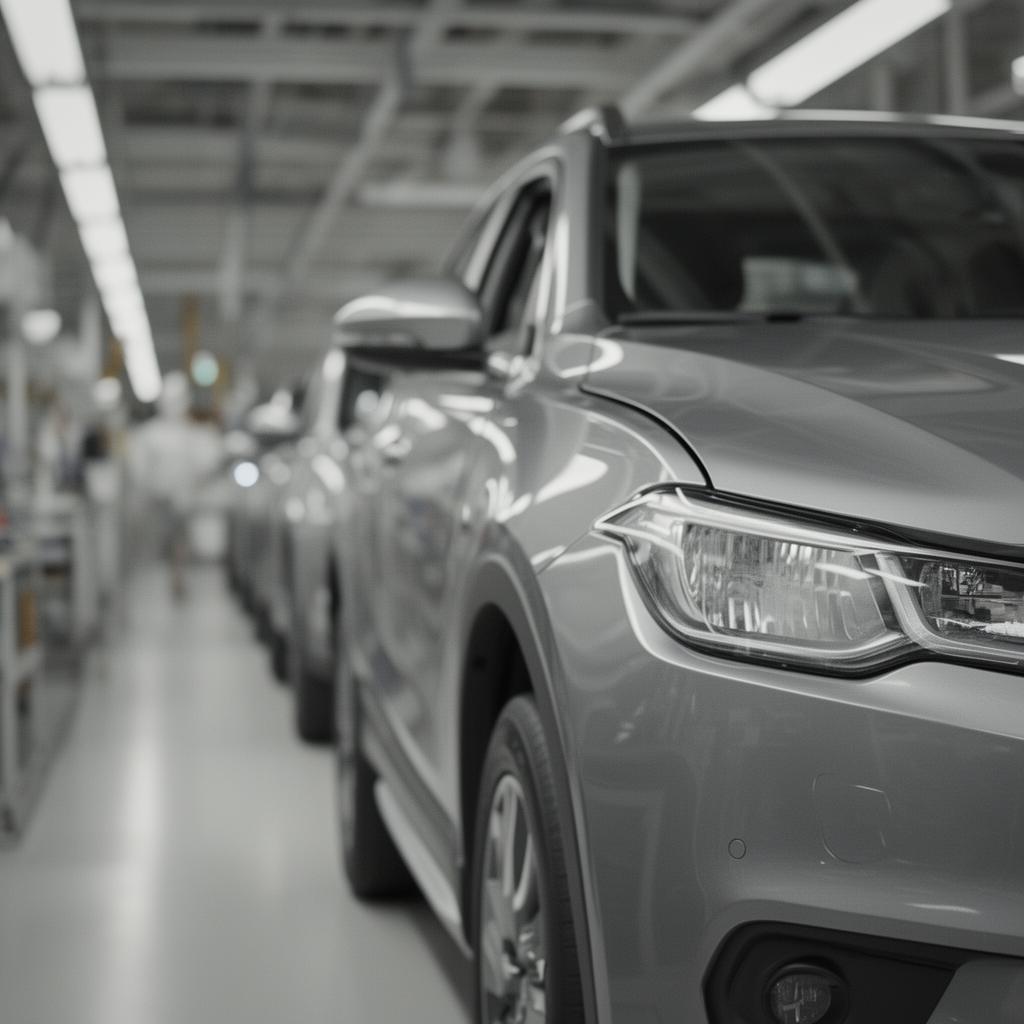
German passenger car production remains well below its pre-crisis level. In 2019, German plants built 4.66 million vehicles; in 2024 the figure was 4.07 million and in 2025 exactly 4,148,836 cars, 11.0% below 2019. The slight recovery from 2024 to 2025 has not continued: from January to August 2026, 2,651,600 vehicles were produced, 4% fewer than in the same period of the previous year. Notably, new registrations in Germany rose by 5% over the same period. A recovery of the home market therefore does not automatically secure the utilisation of German plants.
Employment follows volume with a lag. At the end of June 2026, the WZ29 sector (motor vehicles and parts, establishments with 50 or more employees) counted 691,500 employees, 5.8% fewer than a year earlier. Among manufacturers of parts and accessories (WZ29.3), employment had already fallen by 11.1% in 2025, compared with only 2.1% among vehicle and engine manufacturers (WZ29.1). The supply chain is thus bearing a disproportionate share of the adjustment.
The OEMs expanded their programmes over the course of 2026. On 20 December 2024, Volkswagen agreed to cut more than 35,000 jobs in Germany by 2030 and to reduce technical capacity by 734,000 vehicles; by June 2026, more than 28,000 later departures had been contractually agreed. The Group's "Future Plan 2030", approved on 3 September 2026, adds around 50,000 additional job cuts worldwide, roughly half of them in Germany. Audi plans to cut up to 7,500 jobs in indirect functions by 2029; Porsche around 1,900 jobs by 2029 plus 2,000 expiring fixed-term contracts and a further 5,000 jobs by 2035. Mercedes-Benz has set a technical capacity of 2.2 million vehicles worldwide for 2028, 900,000 of them in Germany, a calculated share of 41%. BMW confirmed a voluntary severance programme on 30 July 2026 with fixed-cost effects from 2027, without naming a headcount figure. The whitepaper explicitly warns against adding up group and brand programmes: technical capacity and actual production are different measures.
China adds further strain. In the first half of 2026, VW Group deliveries there fell by 25.9% to 973,000 vehicles, BMW's by 20.4% to 261,773, Mercedes-Benz's by 28% to 210,245 and Porsche's by 32% to 14,501. Because many of these vehicles are built locally, this does not translate into an equally large drop in exports – but export models, component supplies, development contracts and the groups' investment headroom come under pressure.