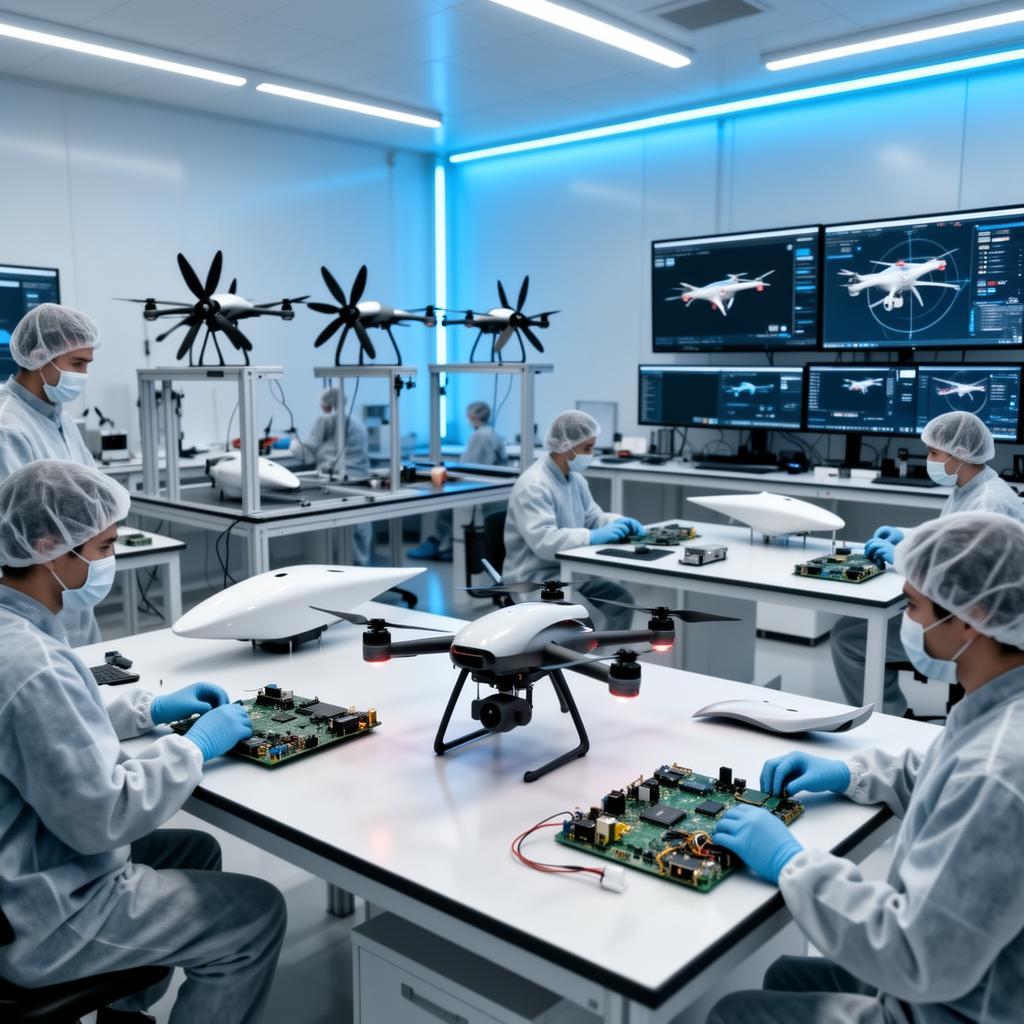
2026 Defence & Aerospace R&D landscape
Research and development in the European defence and aerospace industry — investment dynamics, technology priorities and structural bottlenecks.

Research and development in the European defence and aerospace industry — investment dynamics, technology priorities and structural bottlenecks.

The build-up of European defence budgets is often read as a cycle — a reaction that will fade with the situation. The R&D side suggests otherwise: multi-year program commitments, new capability fields and institutionalized funding structures point to a durable shift. For suppliers and investors this changes the basis of valuation.
European defence and aerospace R&D budgets rise durably — not cyclically.
Autonomy, sensors, space and AI dominate the new R&D agenda over classic platform topics.
Time from prototype to fielded system now decides market position — no longer pure technology depth.
Mid-cap system suppliers are the bottleneck for the ramp curve of European programs.
Civil technologies flow faster into defence programs — cooperations and M&A reshape the market.
Frame the technology priorities and structural bottlenecks of European defence R&D.
Recalibrate investment and portfolio decisions along the demand dynamics.
Target scalability, time-to-fielding and supplier dependencies deliberately.
A grounded view on R&D intensity, dual-use potential and consolidation moves.
The difference between a budget cycle and a structural shift lies in commitment duration. Cyclical funds flow into procurement and can be scaled back quickly. Structural funds flow into research, development and capability building — binding people, infrastructure and program architecture for years.
That is precisely the shift visible in Europe. The share going into R&D and capability development is growing with its own program logic and funding architecture, creating a planning basis that extends beyond individual budget years.
For companies in the sector this changes the investment decision: capacity, qualification and certification pay back only over multi-year horizons. Treating the build-up as a cycle means building too late.
Classic platform programs — aircraft, vehicles, ships — retain volume but lose leadership in R&D prioritization. Capability fields take their place: autonomy and unmanned systems, sensors and sensor fusion, space and connectivity, AI-supported situational awareness and effects chains.
This is more than a change of topic. Capability fields cut across platforms and are less tied to any single one. They therefore also change the value chain architecture: software, sensor and data competence moves closer to the system core, classic structural manufacturing further away.
For suppliers this raises an uncomfortable positioning question: does our competence lie in the platform or in the capability? The answer determines whether the company grows with the build-up or becomes an interchangeable manufacturing supplier.

Technological depth used to decide a system supplier's market position. Increasingly the decisive factor is the time from prototype to a fielded, qualified and logistically supported system.
The reason lies in demand dynamics. Capabilities available two years earlier displace technically superior solutions that arrive later, because procurement decisions are tied to windows. Development process, qualification strategy and industrial maturity thereby become competitive factors of the same rank as the technology itself.
Operationally this moves the bottleneck from development into industrialization: qualification, test and approval processes, serial readiness and spare parts supply. Without reliable lead times there, better technology still loses.
The European program ramp-up presupposes a supplier base able to scale volume. That is exactly where the structural bottleneck sits: mid-cap system suppliers are configured for lot sizes and cycle times matching past demand, not announced demand.
Scaling is not a pure capacity question for these companies. It requires pre-financing, qualified staff, additional test equipment and in many cases extended certifications. All four have long lead times, and all four compete with the running business.
A characteristic risk follows: order books fill faster than the ability to work them off. Full books with unresolved scaling are not a security position but a liquidity and contract risk.
The inflow of civil technologies into defence programs is accelerating — most clearly in autonomy, sensors, connectivity, data processing and AI. This opens the market to suppliers that were not classically part of the defence industry and changes the competitive structure of established supply chains.
For established suppliers this means additional competition exactly where value creation is growing. For civil technology providers it means access to a market with different requirements for qualification, documentation and delivery reliability.
Both drive cooperation and M&A, and the movement runs in both directions: defence companies acquire technology competence, technology companies acquire program access and qualification experience.
The structure of spending points to durability. Cyclical budgets flow mainly into procurement and can be scaled back quickly. The current build-up instead commits research, development and capability building across multi-year program architectures — with people, infrastructure and funding structures that cannot be redirected year by year.
Autonomy and unmanned systems, sensors and sensor fusion, space and connectivity, and AI-supported situational awareness. These capability fields displace classic platform topics at the top of the R&D agenda. Their defining feature is that they cut across platforms, moving software, sensor and data competence closer to the system core.
Time-to-fielding is the time from prototype to a fielded, qualified and logistically supported system. Because procurement decisions are tied to windows, earlier-available capabilities displace technically superior solutions that arrive later. Development process, qualification strategy and industrial maturity thereby rank alongside the technology itself as competitive factors.
Because it is configured for the lot sizes and cycle times of past demand. Scaling requires pre-financing, qualified staff, additional test equipment and often extended certifications — all long lead-time items competing with the running business. The typical risk is therefore not an empty order book but an overfull one with the scaling question unresolved.
A growing one. Civil technologies flow into defence programs fastest in autonomy, sensors, connectivity and AI. This opens the market to suppliers outside the classic defence industry and raises competition exactly where value creation is growing. Cooperation and M&A run in both directions: program access in exchange for technology competence.
Be the first to receive new NEXERY studies, whitepapers and trend radars — concise, no marketing, unsubscribe anytime.
As an independent, AI-powered performance improvement and restructuring firm, we respond personally, confidentially and within 24 hours — whether an earnings and cost programme, operational improvement or restructuring in a special situation. The earlier we talk, the more room to manoeuvre remains.